Have you seen the movie “Night at the Museum”, where everything in the museum comes to life?
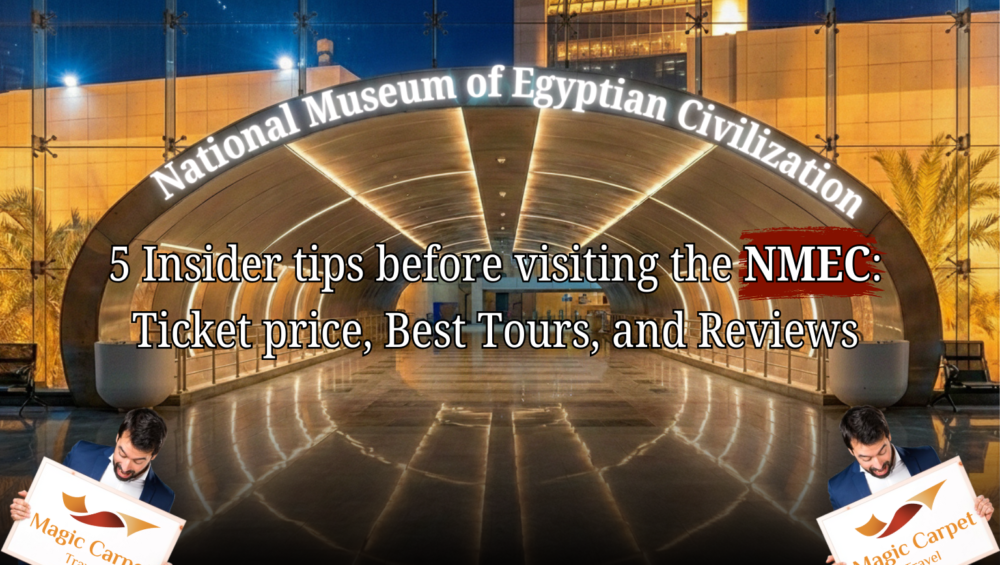
This is exactly what you’ll find when you visit the National Museum of Egyptian Civilization (NMEC), where you’ll find the artifacts, antiques, and mummies -from all the eras and epochs that came across Egypt- unfolding to you and allowing you to go back in time and live in those eras.
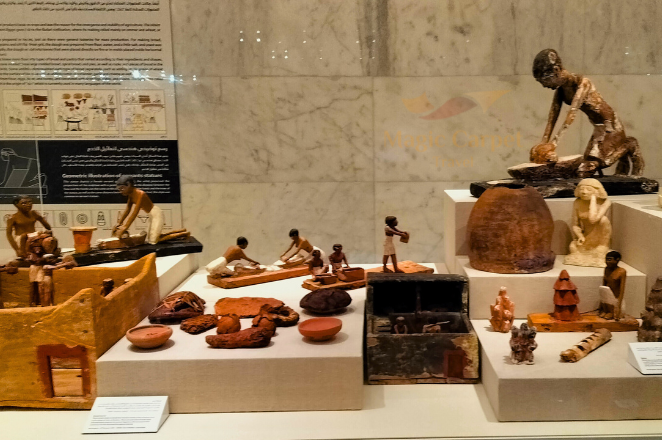
From ancient Egyptian times, to Coptic & Islamic epochs, and ending with the 20th-century lifestyle in clothing and beauty tools.
And of course, the pinnacle of the National Museum of Egyptian Civilization, the 20 royal mummies of some of the strongest Kings and Queens who once ruled Egypt.
But as you’re planning to visit Egypt, you might ask the following questions:
- What are the highlights of the NMEC?
- How does the National Museum of Egyptian Civilization differ from the Grand Egyptian Museum?
- What is the ticket price of the NMEC and its reviews?
- And finally, what are the best tours that include the National Museum of Egyptian Civilization available you should take?
That’s what we’ll answer in the following lines.
But before we get into the highlights, read more about the Ultimate GUIDE of Egypt Packing List and Travel Budget
Highlights of the National Museum of Egyptian Civilization
What are the NMEC Exhibits?
The marbles of the National Museum of Egyptian Civilization are spread over 12 sections that are:
Royal Mummies Gallery
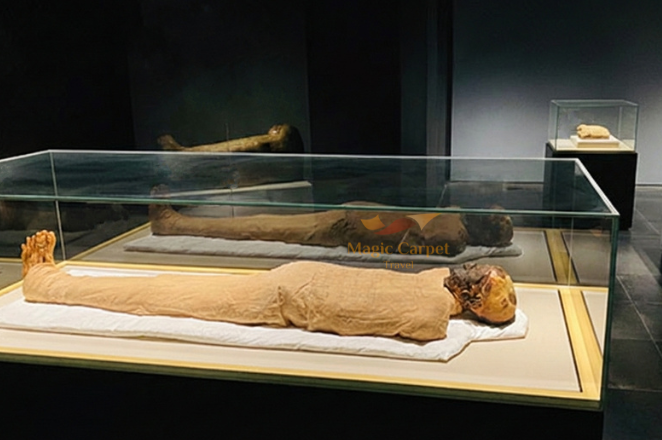
Just as we mentioned earlier, the Royal Mummies Gallery is considered the pinnacle of your National Museum of Egyptian Civilization tour.
There, you’ll get to meet 20 mummies of the greatest kings and queens who once ruled Egypt (17 Kings and 3 Queens) and were buried in Luxor West Bank, who are:
Kings
- Seqenenre Taa II
- Ahmose I (Founder of the 18th Dynasty)
- Amenhotep I
- Thutmose I
- Thutmose II
- Thutmose III (Egypt’s greatest military pharaoh)
- Amenhotep II
- Thutmose IV
- Amenhotep III
- Seti I
- Ramses II (Known as Ramses the Great)
- Ramses III
- Ramses IV
- Ramses V
- Ramses VI
- Merenptah
- Seti II
- Siptah
Queens
- Hatshepsut (Maatkare) (One of the most powerful female pharaohs)
- Ahmose-Nefertari (Queen of the 17th Dynasty)
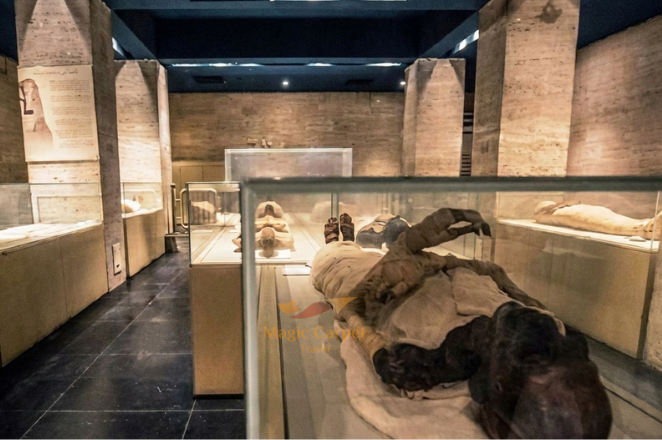
Main Gallery
It takes you on a chronological journey that began 35,000 years ago, as it includes the many artifacts and antiques from the ancient Egyptian, Greek, Coptic, and Islamic epochs, such as:
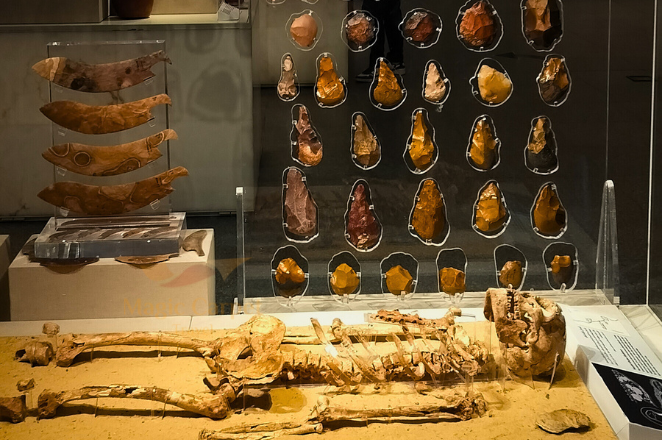
- Nazlet Khater Skeleton: A human skeleton that’s 35,000 years old and is the second-oldest Egyptian human skeleton. This redefines our knowledge of the real age of the ancient Egyptian civilization; it could not only go back to 7,000 years, but even 70,000 years ago.
- Akhenaten Statue: One of the marbles of the National Museum of Egyptian Civilization that stands majestically, which was found at the Karnak Temple in Luxor, and dates back to 1300 BC.
Read More: Top 5 Tips & Hotels for the Perfect Luxor Holiday
- Prosthetic Toe: An artifact from Luxor, dating back to almost 1000 BC. It’s considered one of the oldest functional prosthetics in the world. It was designed to be worn with sandals, indicating that ancient Egyptians practiced advanced, practical medicine, not just ritual or cosmetic purposes.
- Nilus Statue: A statue that embodies the Greek and Roman god of the Nile. It reflects Egypt’s cultural blending under foreign rule: an Egyptian sacred symbol reimagined in classical style, linking Egyptian beliefs with Greek and Roman artistic language.
- Dush Citadel Treasures: From the Roman era, dating back to 300 AD. It shows that even in remote oases, life under Rome was wealthy, organized, and multicultural. The finds reveal a strategic desert hub where military, trade, and religion all met.
- Coptic Dome: A Christian artifact that was found in Assiut, which testifies to the Egyptian painting brilliance.
- Minbar Aboubakr Ibn Mizhar: An Islamic artifact that was used by sheiks to preach the Friday homilies and is an example of the Egyptian crafting greatness.
Textile Gallery
After the “Main Gallery” resides a unique corner in the National Museum of Egyptian Civilization, which is the “Textile Gallery”.
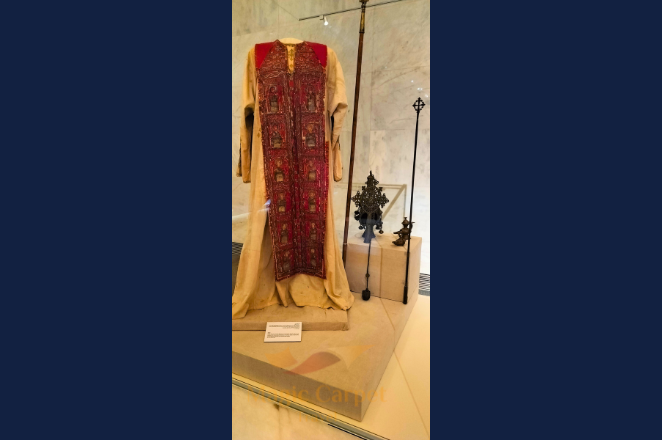
And as the name implies, it showcases almost 600 pieces of different textiles and fabrics, including costumes and rugs such as:
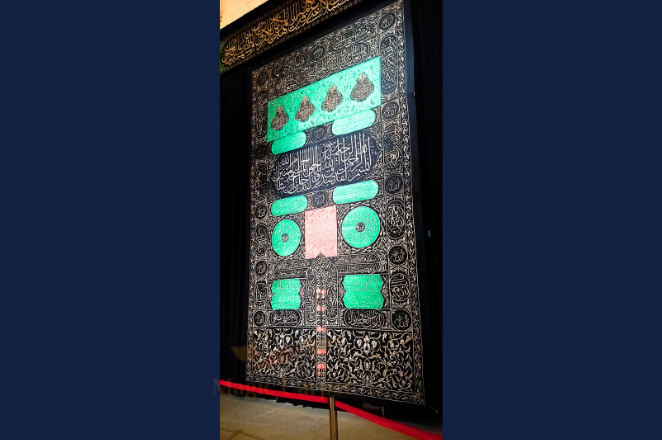
- The Kaaba’s Kiswa: A part of the inner covering of the Kaaba in Mecca. This part is called “Baab El Tawba” or the door of repentance, and dates back to 1941.
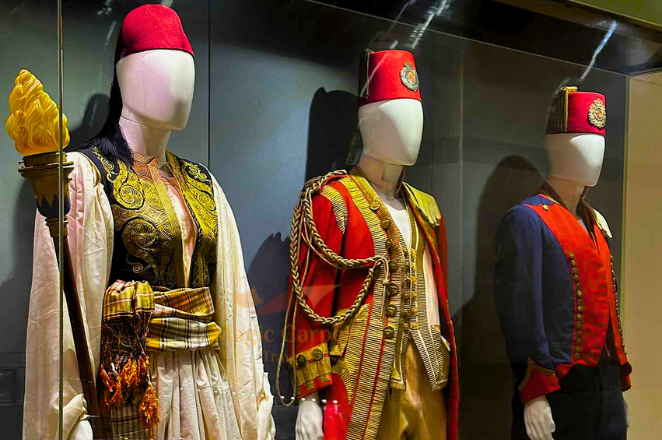
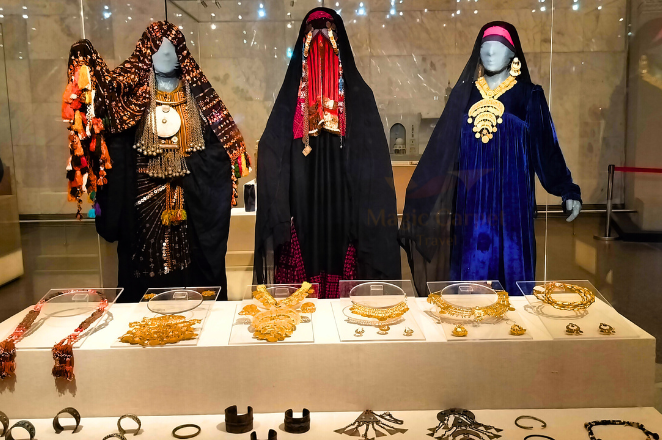
- Historical Uniforms: The NMEC includes different uniforms and costumes of the Muhammad Ali Dynasty’s Service and traditional Sinai women’s costumes.
Dye House
Outside the walls of the National Museum of Egyptian Civilization, in the open, resides the ancient dye workshop dating back to the early Fatimid period (10th–12th century AD).
And believe it or not, this remarkably preserved site was found within the NMEC while building the museum itself and is believed to be the only surviving example of Cairo’s historic dye houses, offering a vivid window into the craft and color production that once fueled Egypt’s textile industry.
Conservation Center
This is the place where fragile and almost devastated antiquities get revived and taken care of through sterilization in the anoxia unit, where every piece undergoes precise documentation, ensuring their protection and refinement.
The conservation center at the NMEC includes:
1. Antiquities Receiving Unit
The place where antiquities get documented and examined by experts before preparation for sterilization.
2. Heavy Stones Restoration Unit
As the name implies, this unit at the National Museum of Egyptian Civilization is used for restoring gigantic stones that might be, in some cases, disassembled to revive them once again for display to the visitors.
3. Mummies Restoration
This is where the mummies get taken care of through nitrogen nurseries, temperature and humidity monitoring, and light intensity control.
All this ensures the right restoration process for the mummies of the NMEC to be ready once again to be displayed.
4. Icons and Oil Paintings Restoration Unit
Another vital unit that revives old-sensitive historical icons and paintings through suction devices to remove dust and contamination from paintings, and maybe recolor faint parts with suitable materials.
5. Organic Antiquities Restoration Lab
Any damaged baskets, textiles, papyrus scrolls, or any artifact made from organic materials are restored through special techniques and proper attention.
6. Inorganic Antiquities Restoration Lab
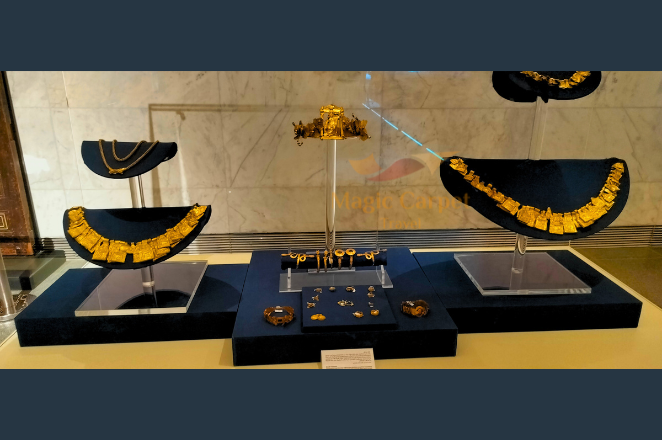
This is where antiques made from inorganic materials like ceramic, glass, clay, or metal, like gold and bronze, are restored through artificial specialized techniques.
Scientific Research Laboratories
The National Museum of Egyptian Civilization includes 17 scientific research laboratories specialized in accurate analyses, which serve work in the archaeological field as well as scientific research in all different fields. It includes the following laboratories:
On your National Museum of Egyptian Civilization tour, you’ll see the scientific labs network that enables the reviving processes of artifacts, mummies, and organic remains, and reveals the secrets that lie behind it.
Here is the full list of laboratories that power this scientific backbone of NMEC.
- Microscopes Unit
- Chromatographic Unit
- Ancient DNA Lab
- Radiocarbon Lab
- Microbiology Laboratory
- Molecular spectroscopy Lab
- Thermal Analysis Lab
- Elemental Analysis Lab
- X-RAY Lab
- Raman Spectrometer Lab
- Particle size measuring Lab
- Anoxia Unit
- Archaeobotany Lab
- Bioarchaeology Lab
- Mobile Lab
- Preparation Lab
- Biobank
Museum Storage
As you know, the number of Egyptian artifacts and antiques is greater than can be viewed by the public visitors.
Thus, the National Museum of Egyptian Civilization houses a storage of 10 units that houses over 50,000 pieces in total.
The storage is designed with an environment that ensures controlled temperature and humidity to offer the best conditions for the stored pieces.
National Museum of Egyptian Civilization vs. Grand Egyptian Museum
Which is better to visit: the National Museum of Egyptian Civilization or the Grand Egyptian Museum?
A question that might bother travelers, but there’s no direct answer to it, as it depends on your personal preference.
For example, if you prefer seeing different civilizations, then we advise you to visit the National Museum of Egyptian Civilization, as you’ll see ancient Egyptian, Coptic, Islamic, and modern Egyptian artifacts, rather than the GEM, which is more centered on the ancient Egyptian period.
If you only care to see a lot of artifacts, then you should visit the Grand Egyptian Museum, as it has over 100,000 pieces.
If you prefer a museum with unique exhibits, both have their unique collection of artifacts and pieces, such as:
Grand Egyptian Museum has:
- Full Tutankhamun Collection (over 5000 pieces, including the Golden Mask).
- Grand Hall and Staircase.
- King Khufu’s Boats.
- National Museum of Egyptian Civilization: It features
- Royal Mummies of 20 of the Greatest Kings and Queens, like: (Ramses II – Thutmose III – Hatshepsut).
- Second-oldest Egyptian human skeleton.
If you’re just looking for the cheapest entry tickets, then the NMEC wins, as its ticket price is $11 for adults, whereas the GEM ticket price is $24 per adult.
National Museum of Egyptian Civilization Tours
Looking for the best tour that takes you on the all-epochs-journey at the NMEC that we mentioned?
Then, our “National Museum of Egyptian Civilization Half-Day Tour”
We’ll take you from and to your hotel doorsteps to the historical Fustat city that boasts of history, especially the Coptic & Islamic sites, like the Hanging Church, St George Church, Amr ibn al-As Mosque, the Mausoleum of Imam Al-Shafi’i, and Saints Sergius and Bacchus Church.
Enjoy the storytelling of our certified Egyptologist as he opens your eyes and makes you live in those ancient ages of Egypt, from the very beginning of time to this very day Egyptian heritage.
National Museum of Egyptian Civilization Ticket Price
What is the NMEC Entry Ticket Price?
To save your time from long surfing online, we’ve prepared for you the breakdown of the National Museum of Egyptian Civilization ticket price, as it varies depending on age and nationality:
For Arabs and other Other Nationalities
- NMEC Ticket (Adult): $11
- NMEC Ticket (Child): $6
- NMEC Ticket (Student): $6
For Egyptians
- NMEC Ticket (Adult): 90 EGP
- NMEC Ticket (Child): 45 EGP
- NMEC Ticket (Student): 45 EGP
National Museum of Egyptian Civilization Reviews
If we can lie to you, the reviews can’t!
And in fact, no matter how much we speak of the NMEC, it won’t be enough to give it its due.
Because over almost 30K reviews on Google, the National Museum of Egyptian Civilization has earned 4.7/5 reviews for its exceptional exhibits and displayed artifacts and pieces.
For example, one traveler said “If you have time for only one museum in Cairo, this is the one, without a doubt”
Of course, the crown jewel of the place is the “Royal Mummies Hall”, as travelers show their astonishing experience as they met the Kings & Queens who crafted many temples & eras of Egyptian primacy and civilization like Rameses II, Thutmose III, and Hatshepsut.
Also, the travelers admired:
- The chronological order of the NMEC and how each epoch came across Egypt is displayed.
- Cheap ticket price especially for students.
- Cultural diversity of the exhibits.
- The educational values travelers earned at the NMEC.
- The organization and modern day presentation facilities.
- The overall positive and calming atmosphere of the National Museum of Egyptian Civilization.
- The auxiliary facilities cafes, restaurants, and gift shops.
National Museum of Egyptian Civilization Working Hours
What are the National Museum of Egyptian Civilization working hours?
Most of the year, the National Museum of Egyptian Civilization is open daily from 9:00 AM to 5:00 PM, with the last ticket sold at 4:00 PM, from Saturday to Thursday.
On Friday, the NMEC has two shifts and is open daily from 9:00 AM to 5:00 PM, with the last ticket sold at 4:00 PM, and from 6:00 PM to 9:00 PM, with the last ticket sold at 8:00 PM
But during Ramadan, only the last entry changes to be at 3:00 PM instead of 4:00 PM.
FAQ
What are the NMEC exhibits?
The National Museum of Egyptian Civilization (NMEC) tells you the full story of Egypt, from prehistoric times to modern times, all under one roof. The museum is organized into thematic galleries covering ancient beliefs, daily life, writing systems, craftsmanship, and social traditions. The top highlight at the NMEC is without doubt the Royal Mummies Hall, where the majestic pharaohs’ and queens’ mummies are displayed in a dramatic, tomb-like setting that feels both educational and deeply moving.
Which is better to visit: NMEC or the Grand Egyptian Museum?
In this case, there’s no one-size-fits-all answer. NMEC is more focused on the broader story of Egyptian civilization across all eras, including Islamic, Coptic, and modern history, making it ideal for visitors seeking context and cultural depth. Meanwhile, the Grand Egyptian Museum (GEM) is more artifact-heavy and ancient-focused, especially for Old Kingdom treasures near the Giza Pyramids. So, many traveling experts consider both NMEC and GEM complementary rather than competitors.
What is the National Museum of Egyptian Civilization entry ticket price?
For non-Egyptians, the National Museum of Egyptian Civilization ticket price varies as it’s $11 for adults, and $6 for children. For Egyptians, 90 EGP for adults and 45 EGP for children, students, and seniors.
What are the National Museum of Egyptian Civilization reviews?
The National Museum of Egyptian Civilization receives overwhelmingly positive reviews, with around 30,000 reviews on Google and an average rating of 4.7/5. Visitors consistently praise the museum’s modern design, clear chronological layout, affordable ticket prices (especially for students), and strong educational value. The Royal Mummies Hall is the top highlight, often described as a powerful and unforgettable experience where travelers come face-to-face with iconic rulers such as Ramses II, Thutmose III, and Queen Hatshepsut. Overall, reviewers describe NMEC as calm, well-organized, and one of the best museums to visit in Cairo.
What are the National Museum of Egyptian Civilization working hours?
The National Museum of Egyptian Civilization is open daily from 9:00 AM to 5:00 PM and until 9:00 PM on Fridays.
What are the opening hours of the National Museum of Egyptian Civilization?
The NMEC opens from 9:00 AM, allowing flexibility for both early visitors and night museum lovers. Hours may vary during Ramadan or special events, so it’s always smart to confirm before visiting.
How do I buy tickets for NMEC?
You can buy NMEC tickets either at the NMEC entrance or through the official booking platforms. Remember, it’s better to book a guided tour via a trusted tour operator that includes tickets, transportation, and a certified Egyptologist. We highly recommend visitors book a guided tour to see history alive in front of your eyes throughout the visit, not only to take selfies!
Where is the Royal Mummies Hall at NMEC?
You’ll find the Royal Mummies exhibit in a dedicated underground gallery inside NMEC. The hall is carefully designed to resemble a royal burial chamber, creating a majestic and immersive experience for viewing Egypt’s most famous kings and queens.
What can children do at the National Museum of Egyptian Civilization?
NMEC is very family-friendly. Children can enjoy interactive exhibits, visual storytelling, and open gallery layouts that make learning about ancient Egypt fun and accessible. Educational tours can also be customized to keep younger visitors engaged.
What are the must-see artifacts at NMEC?
Must-see highlights include the Royal Mummies of famous pharaohs, richly decorated coffins, statues from ancient Egyptian and Graeco-Roman eras, ancient tools, textiles and costumes, and objects that reveal how Egyptians lived, worked, worshipped, cooked, and governed across thousands of years.
How do you get to the National Museum of Egyptian Civilization in Cairo?
NMEC is located here in Fustat, Old Cairo, and is easily accessible by taxi, ride-hailing apps, private car, or organized tour. Many visitors combine their NMEC visit with nearby attractions such as Coptic Cairo, the Citadel, or Old Cairo churches.